Basics of a chain drive
Wear elongation
As the chain runs around the sprocket, it is exposed to varying loads. Power transmission occurs exclusively in the so-called load strand, where the chain is pulled by the drive sprocket. On the opposite side, the chain moves away from the drive sprocket and is unloaded. This section is referred to as the slack strand.
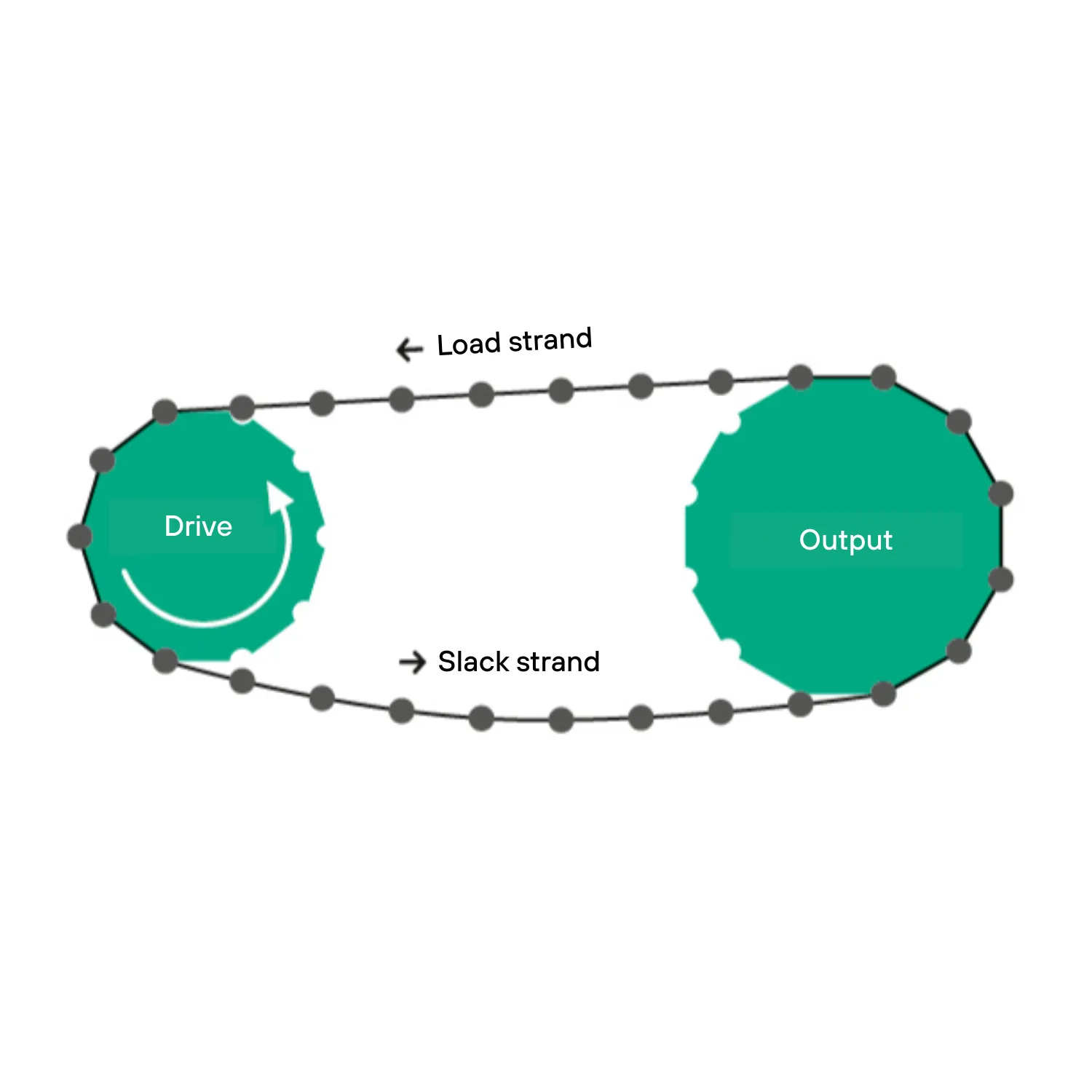
Load strand and slack strand
In the load strand, the chain moves toward the drive sprocket. Power transmission takes place exclusively in this section of the chain. In the slack strand, the chain moves away from the drive sprocket.
Polygon effect
A chain wraps around the sprockets in the shape of a polygon. As a result, the effective diameter of the sprocket and the corresponding chain speed fluctuate. This irregularity in chain advancement is known as the polygon effect, which can lead to uneven chain operation, vibrations in the drive system, high additional forces, and ultimately premature chain failure. The fewer teeth the sprocket has, the greater the percentage difference in speed.


Sag of roller chains
Due to the polygon effect in the chain strand, the strand lengths change periodically during operation. For this reason, slack in the chain’s slack strand is essential. This sag should be between 1% and 3% of the center distance to avoid additional chain loads.
Permissible sag of roller chains:
- 3% for simple drives
- 2% for high-performance drives
- 1% for special applications such as synchronized motion or positioning
The running-in and wear behavior of roller chains causes continuous elongation and, consequently, increasing sag over time. Since a roller chain can only tolerate limited elongation, compensation for this elongation must be provided. A chain can still function properly despite wear elongation as long as it is regularly re-tensioned and thus continues to operate in its intended condition. If maintenance and re-tensioning are neglected, the sag in the slack strand increases progressively, leading to insufficient chain tension.

Insufficient chain tension
If the chain tension is too low, the wrap angle of the chain around the sprockets is reduced, which can cause the chain to jump over the teeth. This chain skipping results in timing deviations, for example in positioning drives, and can potentially lead to chain breakage. In addition to increased noise levels, insufficient chain tension also causes irregular chain movement, which further accelerates wear.
Excessive chain tension
If the chain tension is too high, the increased surface pressure in the chain joints leads to greater friction, which accelerates the wear elongation of the chain. Due to the high tensile force in the chain, not only the chain but also other machine components such as sprockets, bearings, etc., are subjected to higher stress, which shortens their service life. Friction marks on the chain rollers are a clear sign of excessive tension.
